
Low Level Laser Therapy
What is LLLT?
Low-level Laser Therapy (LLLT), also often referred to as cold laser or therapeutic laser, is the use of low intensity photon energy (light amplification at specific wavelengths) as a treatment modality.
How does LLLT work?
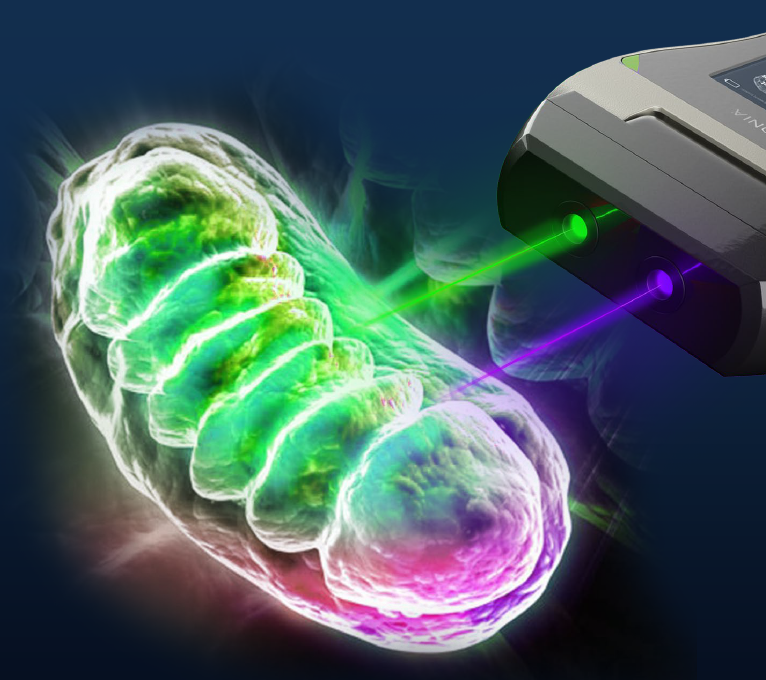
The process of LLLT is based on a photochemical reaction in which discrete bundles of energy called photons are absorbed within the visible light spectrum of 380–700nm. The photon induced chemistry excites the body’s cells, improving cellular energy production (increasing production of cellular ATP), reducing inflammation, reducing free radical production and oxidative stress, improving blood flow, and enhancing tissue repair.
What is the difference between LLLT and other light therapy such as LEDs and Class 4 Lasers?
Light from LEDs (Light Emitting Diodes) cannot achieve the same narrow band of wavelength as a laser. Instead LEDs produce light that is disorganized or incoherent. Laser light is more effective in producing photochemical effects than LED. This is evident in numerous, double-blind, placebo controlled clinical trials using LLLT, where test subjects established both statistical significance and clinically meaningful results over the placebo group which received LED treatment.
Devices with a laser output above 500mw are not LLLT. Instead, they are classified as High Intensity Laser (HIL) or Class 4 Lasers. These are thermal lasers which - according to FDA clearance - are intended to “provide topical heating for the purpose of elevating tissue temperature for temporary relief of muscle and joint pain and stiffness, arthritis pain, or muscle spasm, the temporary increase in local blood circulation and/or promoting relaxation of muscle”. LLLT is a powered light-based laser non-thermal instrument with non-heating effect for adjunctive use in pain therapy.
LLLT use wavelengths within the visible light spectrum of 380-700nm. Another type of electromagnetic radiation is infrared (IR) which includes wavelengths higher than 780nm. The infrared light spectrum exhibits strong absorption from vibrations of the water molecule. The result of infrared absorption is heating of the tissue, since it increases molecular vibrational activity. Put simply, while visible light can produce photochemical effects, infrared only produces molecular rotations and vibrations.
Research has demonstrated that lasers using wavelengths in the range of 405-635nm, and dosage levels ranging from 0.5-10 J/cm2 provide optimal health benefits.
At Spine Studios - The Gap, we use and integrate LLLT as part of the individualised, multi-modal management approach.
If you have any specific questions, or want to know if we can help, feel free to contact us to schedule a consultation.
You may benefit from Low Level Laser therapy if you experience or have been diagnosed with:
Acute and Chronic low back pain
Neck and shoulder pain
Plantar fasciitis and heel pain
Tendinopathy
Bursitis
Ligament and joint sprains
Muscle strains
Tinnitus
*Your chiropractor will fully assess you to determine if you may benefit from low level laser therapy.
What To Expect
Your comfort comes first
A gentle but effective experience
References:
Amjad, F., Mohseni-Bandpei, M. A., Gilani, S. A., Ahmad, A., & Hanif, A. (2022). Effects of non-surgical decompression therapy in addition to routine physical therapy on pain, range of motion, endurance, functional disability and quality of life versus routine physical therapy alone in patients with lumbar radiculopathy; a randomized controlled trial. BMC Musculoskeletal Disorders, 23(1), 255. https://doi.org/10.1186/s12891-022-05196-x
Apfel, C. C., Cakmakkaya, O. S., Martin, W., Richmond, C., Macario, A., George, E., Schaefer, M., & Pergolizzi, J. V. (2010). Restoration of disk height through non-surgical spinal decompression is associated with decreased discogenic low back pain: A retrospective cohort study.
Choi, E., Gil, H. Y., Ju, J., Han, W. K., Nahm, F. S., & Lee, P.-B. (2022). Effect of Nonsurgical Spinal Decompression on Intensity of Pain and Herniated Disc Volume in Subacute Lumbar Herniated Disc. International Journal of Clinical Practice, 2022, 1–9. https://doi.org/10.1155/2022/6343837
Connolly, J. A., Luginsland, L. A., Welsh, S., Bexley, J. A., Pirone, J., Thorpe, S., & Schilaty, N. D. (2025). CLINICAL AND IMAGING OUTCOMES OF NON- SURGICAL SPINAL DECOMPRESSION FOR LUMBAR INTERVERTEBRAL DISC LESIONS: A CASE SERIES. 8.
El-Zayat, A. R., Gomah, W., & Aldesouky, A. H. (2019). Spinal decompression therapy as an alternative modality for management of low back pain and radicular pain caused by lumbar disc herniation or protrusion. Egyptian Rheumatology and Rehabilitation, 46(3), 183–188. https://doi.org/10.4103/err.err_34_18
Gaowgzeh, R. A. M., Chevidikunnan, M. F., BinMulayh, E. A., & Khan, F. (2020). Effect of spinal decompression therapy and core stabilization exercises in management of lumbar disc prolapse: A single blind randomized controlled trial. Journal of Back and Musculoskeletal Rehabilitation, 33(2), 225–231. https://doi.org/10.3233/BMR-171099
Henry, L. (2017). Non-surgical Spinal Decompression an Effective Physiotherapy Modality for Neck and Back Pain. Journal of Novel Physiotherapy and Physical Rehabilitation, 4(3), 062–065. https://doi.org/10.17352/2455-5487.000049
Kanna, R. M., Shetty, A. P., & Rajasekaran, S. (2014). Patterns of lumbar disc degeneration are different in degenerative disc disease and disc prolapse magnetic resonance imaging analysis of 224 patients. The Spine Journal, 14(2), 300–307. https://doi.org/10.1016/j.spinee.2013.10.042
Ma, S.-Y., & Kim, H.-D. (2010). The Effect of Motorized Spinal Decompression Delivered via SpineMED Combined with Physical Therapy Modalities for Patients with Cervical Radiculopathy. Journal of Physical Therapy Science, 22(4), 429–435. https://doi.org/10.1589/jpts.22.429
Macario, A., & Pergolizzi, J. V. (2006). Systematic Literature Review of Spinal Decompression Via Motorized Traction for Chronic Discogenic Low Back Pain. Pain Practice, 6(3), 171–178. https://doi.org/10.1111/j.1533-2500.2006.00082.x
Modica, V. D., & Sciarrone, G. J. (2025). The Effectiveness of Non Surgical Spinal Decompression using Magnetic Resonance in Patients with Lumbar Disc Herniation: A Quasi-experimental Study. JOURNAL OF CLINICAL AND DIAGNOSTIC RESEARCH. https://doi.org/10.7860/JCDR/2025/75785.20790
Sherry, E., Kitchener ,Peter, & and Smart, R. (2001). A prospective randomized controlled study of VAX-D and TENS for the treatment of chronic low back pain. Neurological Research, 23(7), 780–784. https://doi.org/10.1179/016164101101199180
Vicari, C. (2024). Impact of Non-surgical Spinal Decompression Combined Protocol on a Lumbar Disc Herniation Predisposing the Patient to Surgical Intervention—A Case Study. Journal of Spine Research and Surgery, 06(02). https://doi.org/10.26502/fjsrs0072

Helping You Move Better, Feel Better and Return to Work and Life With Confidence
Book online for your initial consultation with Dr John or Kristin Grace (The Gap Chiropractors) today.